The Five A's of Applied GenAI at Work
Learning Objectives
After this chapter, you should be able to:
- Classify any AI product on the Five A's continuum using behavioral tests rather than vendor labels.
- Match the level of autonomy to the risk profile of the workflow, with blast radius, auditability, and cost per task as the deciding dimensions.
- Govern AI-assisted coding with the greenfield/brownfield distinction and verification capacity in mind.
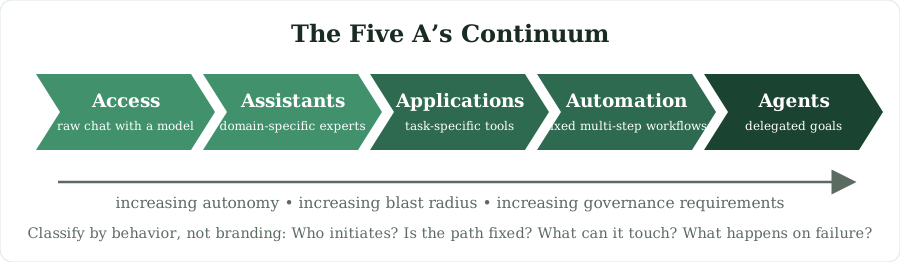
Generative AI at work is moving past the experimentation phase and settling into something closer to a working toolkit. But that toolkit is not one thing. It spans a range of capabilities, from typing prompts into a raw foundation model all the way to handing entire goals over to autonomous systems. Professionals and organizations that want real gains in efficiency and problem-solving need to know where on that range a given tool actually sits.
This chapter sorts the modern AI toolbox through the lens of The Five A's of Applied GenAI. Access is the foundation: interacting directly or through APIs with raw, general-purpose foundation models. Assistants are the domain experts: customised, knowledge-aware chatbots built for a specific topic, team, or workflow. Application is the niche creator: task-specific, single-purpose applications that solve sharply defined problems. Automation is the workflow engine, connecting disparate apps and services so that repetitive, multi-step tasks run themselves. And Agents are the autonomous actors: systems that can independently plan, reason, and execute complex, multi-step goals on the user's behalf.
The framework runs from heavy human involvement at one end (Access) to light supervision at the other (Agents). Knowing where each tool sits helps a worker pick the right one, or the right combination, for the job in front of them.
7.1 Access: The Foundation Models
Everything starts with Access to foundational models. These are the large-scale, general-purpose models (LLMs) trained on vast swaths of internet data, able to understand and generate human-like text, code, and other media. You reach them through a chat interface or through APIs. Think of this "Access" layer as the raw material of generative AI; everything else in this chapter is built on top of it.
Three characteristics define this layer, with one important clarification. The raw model is general-purpose (a jack-of-all-trades for drafting, brainstorming, coding, and summarizing), reactive (it responds to prompts), and frozen at the time of its last training run. But the chat products named above are no longer raw models: by 2026 they ship with built-in web search, persistent memory, file handling, and tool use, precisely the harness layers Chapter 3 described. The distinction matters for buyers, because what you are evaluating in "Access" is really the product wrapper, and the same model can feel current and personal in one wrapper and frozen and forgetful in another.
This category includes the most recognisable names in AI, which serve as the engine for many of the other "A's" in this framework. Notable examples include OpenAI's ChatGPT (powered by the current GPT family), Google's Gemini (in Pro and Flash tiers), Anthropic's Claude (in Fable, Opus, Sonnet, and Haiku tiers), xAI's Grok, and open-weight families such as DeepSeek and Moonshot's Kimi.
Powerful as they are, using these models directly for specialized work gets tedious fast. You end up feeding in context by hand, copy-pasting between windows, and checking every claim against your own private data. That friction is exactly what the next layers exist to remove.
7.2 Assistants: Building Domain-Specific Chatbots
The "Assistant" layer fixes the main weakness of the "Access" layer: a foundational model knows about the world, but it knows nothing about your company, your projects, or your internal documentation. An AI Assistant is a customized chatbot built with that domain knowledge, usually by connecting a foundation model to one or more knowledge sources through Retrieval-Augmented Generation (RAG).
Instead of just chatting with a general-purpose AI, you are now conversing with an expert that has read all your team's documents, understands your product specs, or is trained on your specific area of research.
Assistants are defined by being domain-specific, grounded in a specific body of knowledge such as project documents, codebases, academic papers, or product manuals and knowledge-aware, able to cite sources, answer questions based on private data, and synthesise information from their dedicated knowledge base. They are also persistent and focused, designed to be long-term "colleagues" for a specific role or function rather than one-off tools.
Platforms and examples. Customised GPTs from OpenAI let users build their own GPT through natural-language instructions and uploaded knowledge files; Coze and Poe Bot Builder provide user-friendly interfaces to build sophisticated chatbots; GAIforResearch.com's "Mimi" acts as an intelligent matchmaker for researchers; Notion AI integrates deeply into Notion workspaces; and Microsoft's enterprise Copilot can reason over organisational emails, chats, meetings, and documents.
The payoff is unglamorous but real: far less time spent hunting for the document that already answers your question.
7.3 Application: Integrating GenAI into Products and Services
The "Application" layer embeds generative AI directly into products, platforms, and digital experiences. Rather than standing up isolated chatbots, organizations fold GenAI features into their core offerings, so the AI shows up in context, right where the work happens.
The best examples slot AI into workflows users already know. For example, Catlendar uses Google's Gemini model to allow users to turn a meeting agenda into a set of calendar event files, dramatically speeding up event planning. Another example is Duolingo, which has introduced an AI-powered video call function to facilitate real-time language practice with personalized conversational feedback inside the learning app.
Applications are typically single-purpose, designed to do one thing well; they are increasingly no-code or low-code, built through natural-language prompts, simple forms, or visual interfaces; and they tend to solve niche problems, filling the long tail of software needs that are too specific to justify large-scale app development.
Platforms enabling this layer. Google AI Studio, Lovable, Poe App Creator, and Replit are increasingly used with AI SDKs to quickly build and host niche web applications. In practice this layer turns employees into citizen AI developers, each assembling a personal toolkit to sand down the frictions in their own daily work.
7.4 Automation: Automating Repetitive Workflows
The "Automation" layer connects AI to the wider digital ecosystem. An Assistant gives you answers; an Automation platform takes action. These platforms specialize in routine, multi-step workflows that span several applications and services, the kind of repetitive plumbing work nobody wants to do by hand.
7.4.1 Key Automation Platforms
Leading platforms include Zapier (no-code with 7,000+ app integrations), Make.com (visual workflow design with conditional logic), n8n (open-source with self-hosting options), and Dify.ai (focused on AI-enhanced workflows with LLM integration). OpenAI Agent Builder represents emerging tools that blend advanced workflow automation with agentic capabilities. Traditional RPA leaders like UiPath and Automation Anywhere continue to evolve by integrating AI models.
7.4.2 Advanced Use-Cases and Complex Automations
Workflow automation enables complex orchestrations such as intelligent document processing (automating invoice processing), adaptive customer service (sentiment-based ticket routing), AI-driven sales outreach (lead research and personalized emails), and automated onboarding (provisioning accounts across multiple systems).
7.4.3 Challenges in Workflow Automation
Deploying effective workflow automation presents challenges including integration complexity, API limits and reliability, security and data privacy concerns, data quality dependencies, and ongoing maintenance and monitoring requirements.
7.4.4 The Evolving Role of AI within Workflow Automation
AI is becoming integral to modern workflow automation through LLMs as workflow engines, AI-driven decision points, intelligent data extraction combining OCR and NLP, and generative AI for content creation. The shift matters: automation stops being a script that executes fixed instructions and starts behaving like a process that can respond to what it encounters.
7.5 Agents: Performing Tasks Autonomously
The final "A" is Agents, the most advanced paradigm in this framework: AI systems that pursue sophisticated, multi-step goals with minimal direct human oversight. Assistants answer questions. Automations follow predefined workflows. Agents go further and independently achieve outcomes.
Autonomous agents are built to understand high-level objectives, decompose them into manageable subtasks, select and use the right tools, interact with external systems, learn from ongoing feedback, and dynamically adjust their strategies to achieve goals. For instance, some banks now implement agentic AI systems to automatically handle customer complaints: the agent not only responds to the customer's initial inquiry but can also investigate the claim, process a refund or arrange a replacement item, and send follow-up notifications, all without human intervention. Similarly, agentic AI can be tasked with scheduling meetings by negotiating across multiple calendars, sending invites, and handling reschedules or conflicts thoughtfully. In e-commerce, advanced agents can track delayed deliveries, open support cases with shipping providers, and issue compensation to affected customers, closing the loop on customer care in a fully automated fashion.
A Note on "Agent" Hype: The word "agent" is now stamped on nearly everything. In my experience reviewing vendor pitches, most products sold as "agents" are really advanced Assistants or Automations wearing a fashionable label. True autonomous agents show genuine independence, adaptability, and self-correction, and those capabilities are still emerging rather than common.
7.5.1 Characteristics and Examples
Unlike assistants or automation platforms, agents exhibit independence through planning and reasoning, tool use, self-correction, task decomposition, and proactive behavior. The pattern was pioneered by experimental projects like AutoGPT in 2023, but by 2026 agents are shipping products: deep research agents that conduct multi-step investigations and produce cited reports, computer-use agents that operate a browser or desktop the way a person would, and, above all, coding agents.
7.5.2 Advanced Agent Platforms (2026 Snapshot)
Coding agents are the killer category. Anthropic's Claude Code and OpenAI's Codex (past five million weekly active users) plan multi-hour engineering tasks, edit entire codebases, run tests, and iterate until the tests pass, working through the loop-engineering pattern from Chapter 3. Agentic IDEs such as Cursor and Windsurf embed the same capability inside the developer's editor. These matter to non-engineers too, because they are the tools an executive's prototype gets built with, in days rather than quarters.
The connective tissue is the Model Context Protocol (MCP), an open standard (originated by Anthropic, since adopted across OpenAI, Google, and Microsoft) that lets any agent connect to any tool or data source through a common interface. Before MCP, every agent-to-system integration was custom work; after it, an agent can plug into your CRM, data warehouse, or ticket queue the way a laptop plugs into any USB-C dock. When you evaluate an "agentic" product, one of the sharpest questions you can ask is simply: what can it connect to, and through what standard?
General-purpose autonomous agents such as Manus popularized "fire-and-forget" delegation, asynchronous cloud execution with transparent progress visualization, and enterprise platforms now offer fleets of specialized office agents for research, reporting, and analytics. Orchestration frameworks (LangGraph, the OpenAI Agents SDK, the Claude Agent SDK) let teams compose these into the workflow graphs described in Chapter 3. The practical differentiators to probe in any vendor pitch: observability (can you see why the agent did what it did?), permissioning (what is it allowed to do without a human?), and evals (how is quality measured?).
7.5.3 The Coding-Agent Workbench: Claude Code, Codex, OpenCode, Antigravity, Kimi Code
The coding agents deserve a closer look, because their name undersells them. Five tools define the category in 2026: Anthropic's Claude Code, OpenAI's Codex, the open-source OpenCode (which works with any model, closed or open-weight), Google's Antigravity (Google's agent-first development environment), and Moonshot's Kimi Code, the open-weight ecosystem's answer. All five share the same anatomy: an agent that plans, reads and writes files, runs commands, checks its own results, and iterates, the loop-engineering pattern of Chapter 3 packaged as a product.
Calling them "coding" agents is like calling a spreadsheet an "accounting" tool: the label describes the first users, not the capability. Because these agents operate a real computer, they can do anything a person at a computer does: analyze a folder of spreadsheets and draft the summary memo, reorganize a document archive, scrape and reconcile data, generate reports on a schedule, build the small internal tools this book keeps mentioning. And because they speak the Model Context Protocol, they connect to the rest of your stack, the CRM, the ticket queue, Slack, the data warehouse, and can call any API. The connective standards also make work portable across them: the same MCP servers, project instructions, and skill files that teach one agent your context can move to another with little friction, so switching agents, or running several side by side, does not mean starting over. That matters strategically: the workbench layer is competitive and open enough that lock-in stays low.
For an executive, the practical significance is the one Chapter 14 builds on: these workbenches are how a working prototype gets built in days. The FDE playbook's "build" week assumes exactly this tooling, an agent connected through MCP to the systems that matter, supervised by someone who knows what "good" looks like. Learning to drive one of these tools for an afternoon will teach you more about the real state of AI capability than a quarter of vendor briefings. Chapter 15 examines coding agents as a management problem, from loop design to governance and adoption, and Chapter 16 is the hands-on tutorial.
7.5.4 Vibe Coding and the Technical Debt Challenge
One of the most promising, and most perilous, uses of AI agents in the workplace is autonomous code generation, colloquially termed "vibe coding": developers describe what they want in natural language and AI agents write the implementation. As a productivity story, the numbers are hard to ignore, provided they are attributed honestly: the widely cited 55% figure comes from GitHub's 2023 controlled study of Copilot autocomplete (developers finished a task 55.8% faster), not from autonomous agents, for which rigorous productivity evidence is still thin. What agents demonstrably change is scope: high-level intentions become working code in hours rather than weeks.
Here is the catch. Those productivity gains often mask a hidden liability: technical debt accumulating faster than anyone notices. Technical debt is a "complexity tax", the future engineering effort required to pay for shortcuts, suboptimal implementations, or quick fixes made during initial development. AI-assisted coding can run up this tab quickly, by generating duplicate code across different modules, creating integration conflicts between AI-generated components and existing systems, and introducing subtle architectural inconsistencies that compound over time.
The Greenfield vs. Brownfield Divide: The risk profile of AI-assisted coding varies dramatically depending on the development context. In "greenfield" projects, new systems built from scratch with no legacy constraints, AI agents operate relatively safely. These environments provide clean slates where AI can establish consistent patterns and architectural approaches without navigating pre-existing complexity. However, the strategic risk escalates substantially in "brownfield" environments, legacy systems with accumulated complexity, undocumented dependencies, and intricate architectural decisions made over years or decades.
In brownfield contexts, AI agents face a limitation that has shifted shape but not disappeared. With million-token contexts and repository indexing, modern agents can technically read most codebases; what they still cannot read is everything that never made it into the code, why architectural decisions were made, which constraints are load-bearing, what the system's history punishes. The binding constraint has moved from context to verification: the agent can produce plausible changes faster than the organization can check them against its unwritten rules. This blind spot can lead AI to generate technically correct code that nonetheless violates implicit system constraints or undermines carefully balanced trade-offs in the existing architecture.
Think of AI-assisted coding in a legacy system as hiring a remarkably fast interior designer to renovate an ageing, structurally complex mansion. The designer installs beautiful wallpaper, modern fixtures, and elegant cabinetry at record speed. The surface looks polished and professional. But with no understanding of the ancient plumbing, wiring, and load-bearing walls hidden behind the finish, the designer may sever a critical pipe or overload an outdated circuit. The owner eventually spends far more tearing out the superficial improvements and repairing the damage from the "efficient" renovation than measured work would have cost from the outset.
Managing the Debt Accumulation: Left unchecked, technical debt from AI-assisted development produces progressively unstable delivery cycles, and the stakes are visible in the pre-AI record: accumulated technical debt in legacy systems has grounded airlines and disrupted healthcare providers and financial institutions. AI-generated code did not cause those failures, but a tool that accelerates code production accelerates debt accumulation in exactly the systems that can least absorb it. Avoiding that fate requires rethinking how AI-assisted development is run.
Technical debt management cannot be an afterthought, shoved into "cleanup sprints" that perpetually get deprioritised. It has to become a first-class engineering discipline with dedicated resources and clear accountability. That means explicit quality gates that AI-generated code must pass before integration, testing that validates architectural coherence and not just functionality, and technical debt registries that track the complexity costs as they accumulate.
Perhaps most importantly, code review has to grow from a mechanical approval checkpoint into genuine mentorship. Senior engineers should coach junior developers, and increasingly oversee AI coding agents, on judging code beyond surface-level correctness: does it fit the architecture, what hidden dependencies does it touch, which patterns will age poorly, and where will a seemingly efficient shortcut extract compound interest in maintenance costs later? The most useful mental model I have found is to treat AI agents as talented junior developers who need experienced oversight, not as autonomous solutions. Organisations that do so get the productivity benefits without giving up the architectural integrity and long-term health of their software.
7.6 The 'A' Continuum: A Comparative Analysis
The Five A's are not sealed categories. They sit on a continuum of autonomy, complexity, and user control, and many modern products blend them: an "Application" might be built on an "Access" model, an "Assistant" might trigger an "Automation," and a complex "Agent" inherently draws on all of these capabilities at once.
The key is to understand the primary goal of each layer. The framework moves from raw interaction to creating experts, to building tools, to automating processes, and finally to delegating goals.
An operational test for vendor pitches. Because every product now markets itself as an "agent," classify by behavior, not branding, with four questions. Who initiates? If a human triggers every run, it is at most an Assistant or Automation; Agents act on goals and events. Is the path fixed? If the steps are predefined, it is an Automation regardless of how much AI sits inside the steps; Agents choose their own next action. What can it touch? Read-only access to one system is Assistant territory; write access across systems is agent territory, and should trigger agent-grade governance. What happens when it fails? If failure means a wrong answer a human reads, risk is low; if failure means a wrong action a customer experiences, you are governing an Agent whatever the vendor calls it. The questions also generate the governance dimensions that matter to executives: blast radius, auditability, and cost per task, none of which appear on a demo screen.
Industry Impact and Blended Approaches: Organizations often benefit from hybrid approaches. In customer service, an Assistant handles first-line support, triggers Automations for standard requests, and escalates complex issues to Agents. In healthcare, doctors use Applications for transcription, Assistants for diagnostic support, Automations for billing, and Agents for research. In finance, customers use Assistants for inquiries, loan officers use Automations for processing, and Agents monitor for fraud detection.
7.7 Conclusion
The Five A's (Access, Assistants, Application, Automation, and Agents) give you a working map for applying generative AI on the job. The journey runs from interacting with raw AI (Access) to creating knowledge experts (Assistants), building niche tools (Application), optimizing processes (Automation), and finally delegating complex outcomes (Agents).
Why do the distinctions matter? Because they tell you which tool fits which job. The future of work will not be defined by a single AI but by a blend of all five, and the professionals who thrive will be the ones who know when to chat, when to build, and when to delegate.
Discussion Questions
- Classify your three most recent AI vendor pitches using the four behavioral questions. How many were really the Agents they claimed to be?
- Which single workflow would you promote from Automation to Agent first, and what permission gates and eval evidence would you require?
- Where would AI-accelerated technical debt hurt your organization most, and who currently has the authority to slow a fast-moving team down?