The EDGE Framework for GenAI Value Creation
Learning Objectives
After this chapter, you should be able to:
- Assign any AI initiative to an EDGE pillar with a pillar-appropriate success metric.
- Treat Empowerment as both an enabler and a source of measurable outcomes, and budget for it accordingly.
- Audit a portfolio's pillar balance and read concentration as a strategy statement.
For business leaders, the flood of Generative AI hype is overwhelming. The conversation is often lost in technical jargon rather than focused on the single most important question: How does this technology create tangible value for my business?
While the "Five A's" (Access, Assistants, Application, Automation, and Agents) discussed in Chapter 7 provide a map of what the tools are, we now need a framework for why we deploy them. We must move from a features-first to a value-first mindset.
This chapter introduces the EDGE Framework, a deliberately simple model that helps managers identify, prioritize, and execute on the four primary sources of Generative AI value. Use it to build a practical business case for AI adoption, with every initiative linked to a core strategic driver rather than to enthusiasm alone.
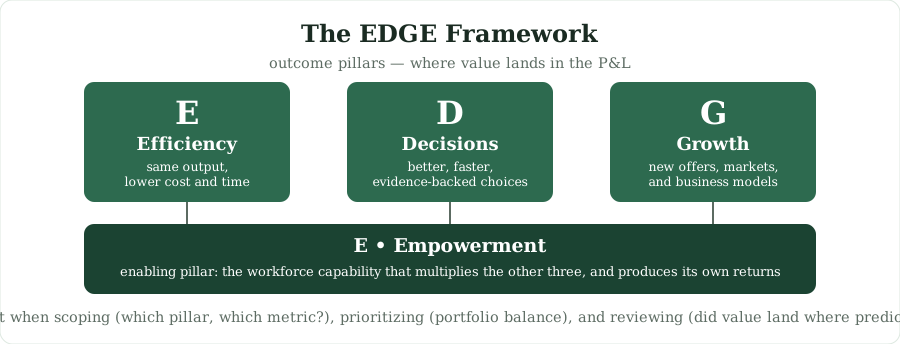
The framework rests on four pillars, Efficiency, Decisions, Growth, and Empowerment, which we will explore not as a simple checklist but as a strategic path, moving from immediate operational gains to long-term market transformation.
9.1 E = Efficiency (Securing the Foundation)
The most immediate and measurable value of Generative AI lies in optimizing your current operations. This is the "low-hanging fruit" and the foundation upon which all other AI ambitions are built.
Definition: Efficiency gains come from the automation and standardization of repetitive, high-volume tasks. This is about doing what you already do, but faster, cheaper, and at a greater scale.
Example in Action: A financial services firm uses Generative AI to automatically summarize earnings call transcripts, generate first drafts of quarterly compliance reports, and create routine client communications. A process that previously consumed 200 person-hours monthly now only requires 20 hours of high-level human review and refinement.
Why This Matters for Managers: This is your "quick win," and the most direct path to measurable ROI. Costs drop, turnaround times shrink, and your team gets its hours back for work that actually needs their judgment. In the companies I have advised, this is also the easiest business case to build, and the credibility it earns is what secures buy-in and funding for the more ambitious AI initiatives that follow.
9.2 D = Decisions (Gaining a Strategic Advantage)
Once Efficiency has freed up resources, the next level of value creation is thinking better, not merely working faster. This pillar uses AI to improve the quality and speed of managerial and strategic decision-making.
Definition: This is about making better, faster choices by using AI to synthesize context-rich insights from massive, complex, and often unstructured data sets.
Example in Action: A retail executive uses an AI platform to analyze millions of customer reviews, social media comments, competitor pricing data, and supply chain signals simultaneously. The system identifies an emerging trend showing customers are willing to pay a premium for sustainable packaging. This was a weak signal, buried across fragmented data sources that no single analyst or team would have connected, but it provides a clear path for a new product and pricing strategy.
Why This Matters for Managers: This pillar is your defense against uncertainty. It reduces decision-making risk in volatile environments and provides competitive intelligence at a speed and scale impossible for human analysts alone. This allows you to spot opportunities and threats earlier than your rivals. It is particularly valuable when you face complex choices with incomplete information, which describes most high-stakes strategic decisions.
9.3 G = Growth (Defining the Future Market)
With efficient operations and smarter decisions in place, you can shift from defense to offense. This pillar carries the biggest potential payoff of the four, because the goal is no longer optimizing your current business model. The goal is creating entirely new ones.
Definition: Growth is achieved by creating AI-native products, services, and operating models that open new revenue streams and fundamentally reshape your competitive advantage.
Example in Action: A traditional legal software company launches an AI-powered research assistant. Where the old product searched documents, the new one generates custom legal memos, predicts case outcomes based on precedent, and drafts initial briefs. That is more than an add-on feature. It is a new product category that could not exist without Generative AI, one that opens a fresh market segment and makes the older search-based tools look obsolete.
Why This Matters for Managers: This defines your future revenue and market position. While competitors are focused on Efficiency, this pillar is about creating offerings that can make current solutions obsolete, including potentially your own. This is critical for long-term survival and leadership as AI reshapes industry boundaries. It helps you move from a defensive posture ("How do we protect our current business?") to an offensive one ("How do we lead the next wave?").
9.4 E = Empowerment (The Human Accelerator)
A note on the framework's logic, because the four pillars are not the same kind of thing and pretending otherwise causes confusion. Efficiency, Decisions, and Growth are outcome pillars: places where value lands in the P&L. Empowerment is the enabling pillar: the human capability that determines whether the other three materialize at all, and which produces its own measurable outcomes (skill acquisition, retention, quality of work) along the way. When Chapter 11 later treats capability transfer as a value outcome in its own right, that is this dual character, not a contradiction: you invest in Empowerment both for its direct returns and because it is the multiplier on everything else.
Definition: Empowerment is the augmentation of human capability and creativity. It equips your workforce with AI tools that act as co-pilots, mentors, and creative partners, so people operate at higher levels of expertise and output than their tenure alone would predict.
Example in Action: A consulting firm equips every junior analyst with an AI assistant trained on the firm's proprietary frameworks and past projects. These analysts can now draft initial strategy frameworks, generate complex data visualizations, and research industry precedents in minutes, not days. As a result, junior analysts produce work quality that previously required 5+ years of experience. This allows senior consultants to focus exclusively on high-value client relationship building and strategic problem-solving.
Why This Matters for Managers: This is the solution to your talent challenges, including skills gaps, hiring difficulties, and employee retention. It dramatically accelerates employee development and flattens the expertise curve, allowing smaller, leaner teams to compete with larger organizations. Critically, it improves employee satisfaction and engagement by removing tedious, "busy work" and allowing them to focus on more meaningful contributions. This is about making your people better, not replacing them.
9.5 From Framework to Action: Implementing the EDGE Strategy
The EDGE framework identifies where to find value; capturing it follows the three-phase roadmap that Chapter 10 develops in full (explore, pilot, scale) and the governance structures described there. Rather than duplicate that material, this section adds what a framework owes its users: an evidence check and a usage discipline.
The evidence check. Each pillar should be grounded in measured, named deployments, not hypotheticals, and the measured record so far clusters as follows. For Efficiency, the best-documented case remains Klarna's AI service agent, which absorbed the workload of hundreds of agents, and whose 2025 course correction (rehiring humans after quality suffered) is discussed honestly in Chapter 11; efficiency gains are real and imitable, and quality is the constraint. For Decisions, the strongest published evidence is decision-support rather than decision-making: the consultant study in Chapter 2 (25% faster, ~40% higher-rated quality inside the technology's competence) and the call-center study showing AI encoding expert judgment for novices. For Growth, the honest state of the evidence is earlier-stage: the pattern catalog in Chapter 11 documents business models being built, while McKinsey's paradox data (Chapter 2) shows most firms have not yet converted adoption into new revenue. For Empowerment, Novo Nordisk's measured Copilot rollout (Chapter 2) is the reference case: 2.17 hours saved per employee per week, with satisfaction driven three times more by quality than by speed. Where this book cannot point to a measured case, it says so, and you should hold your vendors to the same standard.
The usage discipline. Use EDGE at three moments: when scoping (which pillar is this use case serving, and what is the pillar-appropriate metric?), when prioritizing (a portfolio concentrated in one pillar is a strategy statement, intended or not), and when reviewing (did the value land in the pillar you predicted?). The framework earns its keep as a shared vocabulary for those three conversations; the execution machinery lives in Chapter 10 and the appendix.
9.6 Conclusion: Using EDGE as a Strategic Compass
The EDGE Framework is a clear-thinking manager's guide to Generative AI: four distinct, actionable pillars of value creation in place of the hype.
Start with Efficiency to secure your foundation and fund your journey.
Use those gains to improve your Decisions and build a strategic advantage.
Put those new capabilities to work in pursuit of Growth.
And underpin every step with Empowerment, so your workforce grows more capable at each stage.
As a leader, your job is to use this framework as a strategic compass. Look at any proposed AI project and ask which pillar it serves: Efficiency, Decisions, Growth, or Empowerment. (Yes, the acronym has two E's; in conversation, say the pillar names, not the letters.) A simple question, but it keeps every dollar you invest in AI tied to real, measurable business value.
Discussion Questions
- Sort your current AI initiatives into the four pillars. What does the concentration pattern say about your strategy, and is it intentional?
- Which pillar is hardest to measure in your organization, and what proxy metric would you accept rather than leaving it unmeasured?
- Efficiency gains are imitable. Where could yours compound with proprietary data or process redesign into something a competitor cannot copy in a quarter?